
What Is Agentic AI for Analytics?
TL;DR: Agentic AI for analytics is software that can take a goal expressed in plain language ("why did churn rise last quarter?"), decide which data to look at, reason across it, and return an answer — not just render a chart. Unlike a static dashboard (which shows what you pre-built) or a basic chatbot (which answers from text), an analytics agent acts on live data: it interprets the question, queries the right datasets, and explains the result. It's the shift from "read the dashboard" to "ask the dashboard."
A simple definition
An agent is AI that can pursue a goal through multiple steps with some autonomy — understand intent, choose tools/data, take actions, and check its own results. Apply that to analytics and you get an AI that behaves less like a search box and more like a junior analyst: you ask a question in natural language, and it figures out how to answer it from your data.
The key word is agentic. A summary feature describes what's already on screen. An agent decides what to do next — which makes it useful for questions you didn't anticipate when you built the report.
Dashboard vs. Copilot-style assistant vs. agentic AI
It helps to place agentic AI on a spectrum:
Microsoft's Power BI Copilot and Fabric Data Agents sit on the right-hand side of this spectrum — Copilot as an assistant, Data Agents as a genuinely agentic, composable layer.
What makes analytics agents actually work
A trustworthy analytics agent needs more than a language model. The parts that matter:
- Grounding in real data — it must query your actual datasets, not guess. Answers should trace back to the numbers.
- Security and scope — it can only see data the asker is allowed to see. In multi-client settings that means row-level security and tenant isolation are non-negotiable.
- Cross-report reasoning — real questions span more than one report or dataset; a useful agent isn't locked to a single semantic model.
- Explainability — it should show its working, so users (and auditors) can trust the answer.
Why it matters for client-facing and embedded reporting
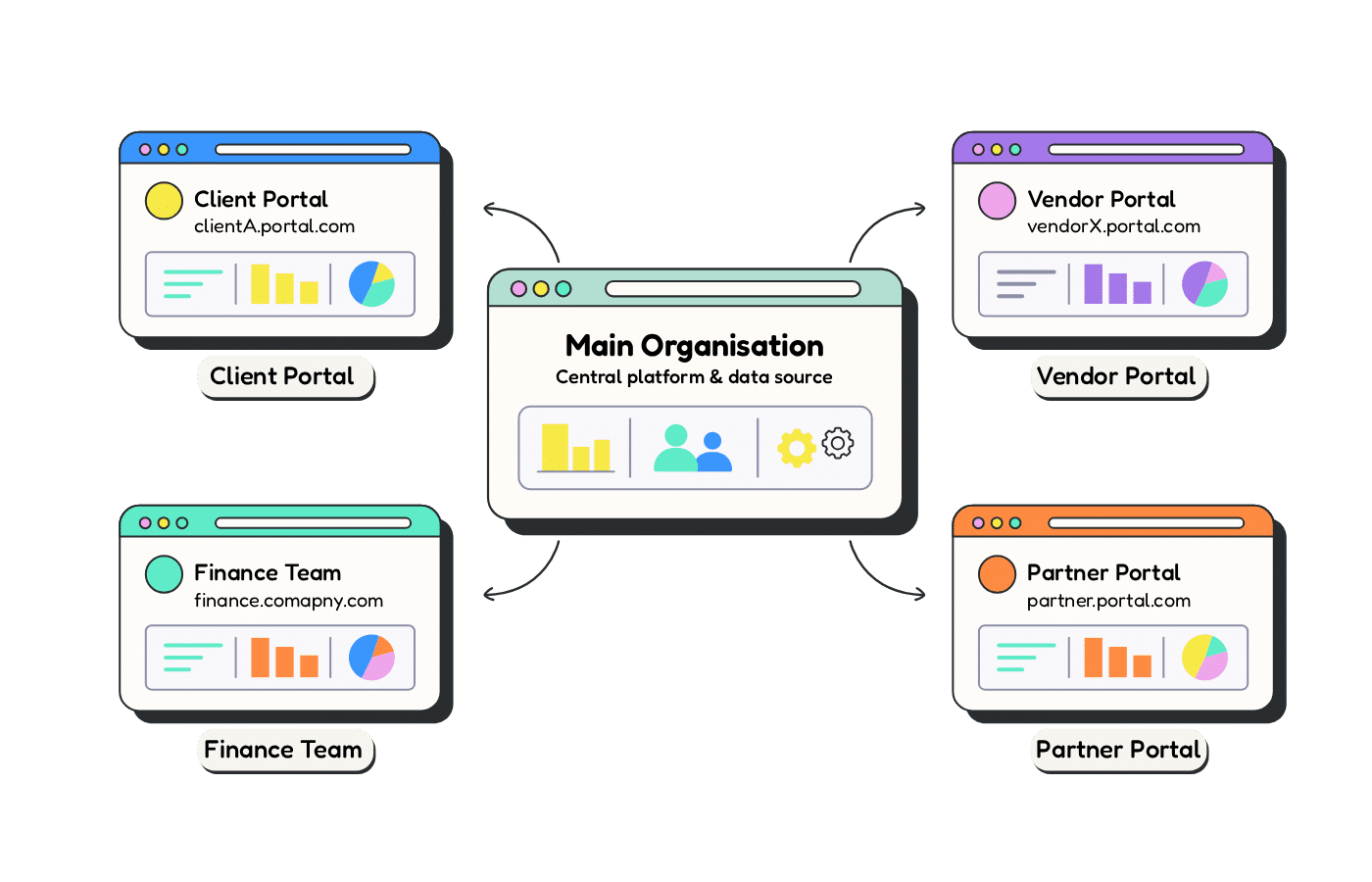
Most agentic-AI-for-analytics conversations assume an internal enterprise where everyone is licensed. But a large share of reporting is external: agencies delivering dashboards to clients, SaaS products embedding analytics, portals serving customers. (That's the whole premise of embedded analytics and multi-tenant analytics.)
For those audiences, the value of agentic AI is huge — clients get answers without learning the dashboard — but the licensing model is the catch. As covered in can you share AI-powered Power BI reports with external users?, Microsoft's native AI runs under each viewer's licensed identity, so it doesn't reach unlicensed external users.
That's why agentic AI for external analytics belongs in the embedding/portal layer, where it can serve viewers on capacity instead of per-seat licenses, stay white-label and multi-tenant, and respect RLS and tenant isolation. (For the underlying capacity model, see Power BI Embedded and Microsoft Fabric capacity explained.)
This is what DataTako's agentic AI does, and it's live today: letting external, portal-based viewers ask their dashboards questions in plain language — branded as yours, isolated per (sub)organisation, and without a per-user Power BI Pro license.
How to evaluate an analytics agent (quick checklist)
- Does it answer from your live data, with traceable results?
- Can it handle questions you didn't pre-build?
- Does it enforce who-can-see-what per user/tenant?
- Can it reason across multiple reports, not one?
- For client work: can unlicensed external users use it, in your branding?
FAQ
What is agentic AI for analytics in plain terms?AI that takes a plain-language question, decides which data to look at, reasons over it, and returns an explained answer — instead of just showing a pre-built chart.
How is it different from a dashboard?A dashboard shows what was built in advance. An analytics agent answers new questions on the fly by querying live data, so it handles things the dashboard author never anticipated.
How is it different from Power BI Copilot?Copilot mainly assists a licensed user in building and summarizing reports. Agentic AI is goal-driven: it interprets a question and acts across data to answer it. See Power BI Copilot vs Fabric Data Agents.
Is agentic AI for analytics safe with sensitive or multi-client data?It can be, when scoped by row-level security and tenant isolation so each user can only ever query data they're permitted to see.
Can external clients use agentic AI on their dashboards?Not through native Microsoft licensing, which requires a licensed identity per user. An embedded, capacity-based portal with its own AI layer can serve external viewers without licensing each one.

