
You want to give your clients insight, not just services. Dashboards become part of your offering. Clients love it. It adds value. It differentiates you, and it also reduces client questions about whatever you’re working on.
It starts small. A few clients. A few users.
Then it turns into license questions, guest accounts, access requests, expired users, shared logins, and workspaces nobody fully understands anymore. Perhaps the following problems sound familiar to you.
Licensing mess
- Do we need a Power BI license for every client user?
- Who pays for it?
- What about external users?
Access management chaos
- Adding users manually
- Removing users when contracts end
- Clients sharing logins (security risk)
Non-Microsoft clients
- Some clients don’t use Microsoft accounts
- B2B guest access becomes messy
Branding problem
- Clients see Microsoft environment, not your service
- Hard to position dashboards as your product
Operational overhead
- Every new client = repeat setup
- Workspaces everywhere
- No central control
What started as a value-add slowly turns into a security, licensing and operational risk.
Dashboards are not the challenge anymore
Building insights is no longer the bottleneck for service providers. You know how to create value from data. You know how to turn numbers into advice, direction, and better decisions for your clients.
The real challenge begins after the dashboard is finished.
Delivering those insights to the right people, in the right environment, without creating licensing confusion, security risks, and operational overhead — that’s where things get complicated. What started as a powerful addition to your service slowly turns into a daily struggle with access, users, and environments.
Power BI works great for internal reporting. One organisation, one tenant, one group of users.
Service providers operate in a completely different reality. You serve multiple organisations, each with their own users, expectations, branding, and access requirements. The tool that helps you build insights was never designed to distribute them as a client facing service at scale.
That gap between building dashboards and delivering them is where the friction lives.
Reporting needs to be delivered like a product
At a certain point, dashboards stop being just an extra feature. They become part of what clients expect from your service. They support your advice, make your work more transparent, and strengthen your position as a long term partner.
But if reporting is part of your service, it should be delivered like one.
Not through workarounds. Not through shared logins. Not through manual guest access and repeated workspace setups. That approach might work for a handful of clients, but it doesn’t scale with your business.
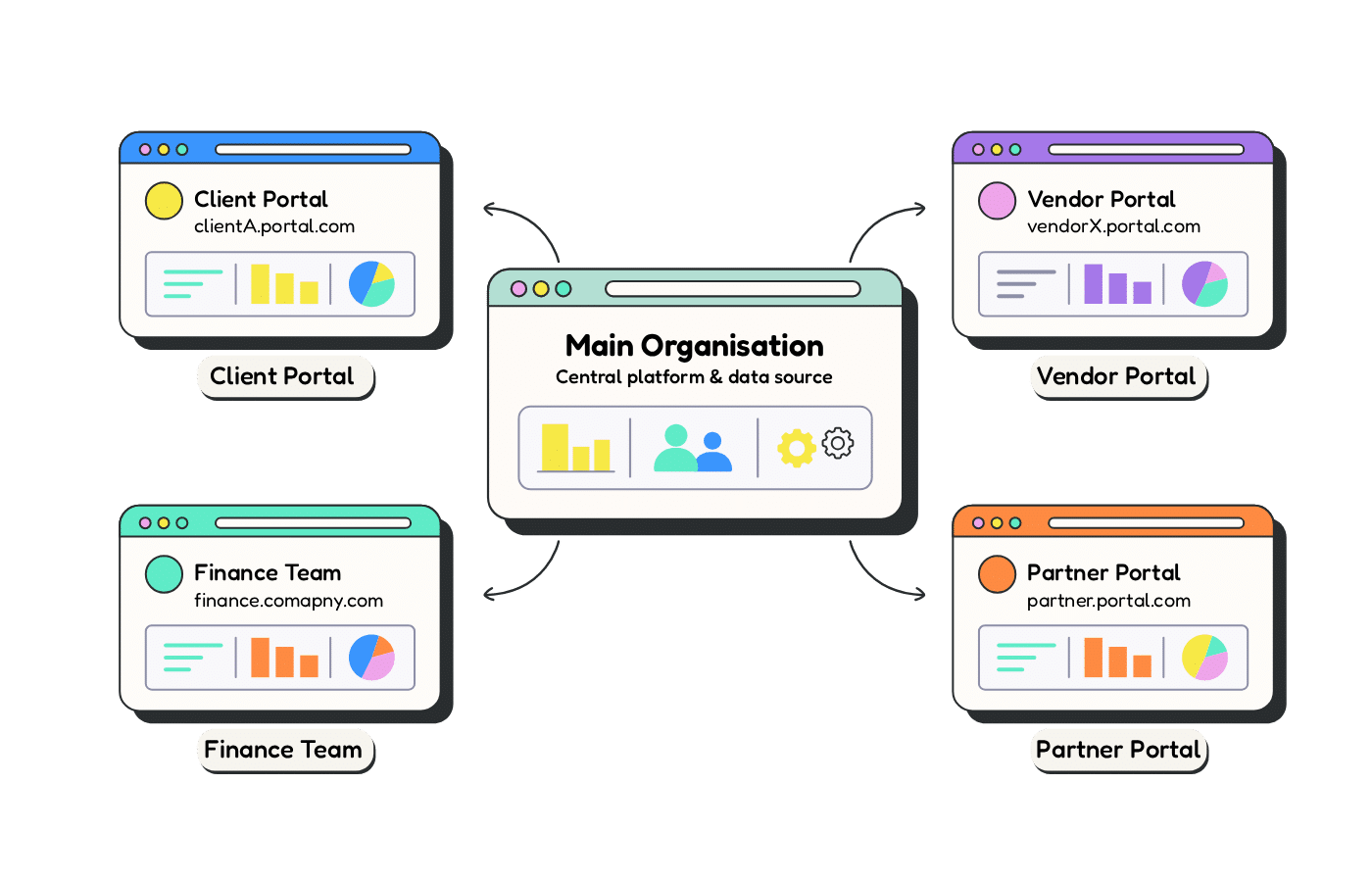
Service providers need a way to manage reports centrally, while delivering them as secure, independent environments per client. Each client should experience their own portal, with their own users and branding, while you keep control of the data, models, and governance behind the scenes.
How do we solve this mess?
The issue is not your dashboards. The issue is that Power BI was never designed as a client-facing distribution platform.
Service providers need a way to deliver dashboards like a product, not like a workaround.
You need a central platform where you manage reports once, and roll out secure, branded environments per client.
This is exactly why we built DataTako. It facilitaties you to focus on your business, your core service offering and takes away all the struggles that come with the distribution part. Heck, turn your reports in a full scale business model without the hassle.
Service providers are not struggling with data.
They are struggling with everything that comes after the dashboard is built.
With DataTako, every client or team gets their own secure, branded environment, while you manage everything from one central environment. You set up reports once and roll them out as independent portals, without complex licensing, guest access or repeated configuration.
Add a new client, assign the reports, apply their branding, and they are live. You stay in control of the data and governance while they get an isolated experience. That’s how reporting becomes a scalable part of your service, not an operational burden.
See how client report distribution really works
Discover how to manage reports centrally and deliver independent environments for every client.
Plan a demo or sign up directly at https://app.datatako.com/register.